What Summer Did to Your Skin — and What Comes Next
Summer is meant to be enjoyed. Your skin just experiences it right along with you.
Kaycee Wallen, Licensed Master Esthetician
Director of Aesthetic Operations

Summer has a way of changing our routines.
There are longer days, weekends outside, vacations, pool days, travel, dinners on the patio—and maybe a few nights when your skincare routine isn't exactly the priority.
And honestly? That's part of summer.
Taking care of your skin shouldn't mean being afraid of the sun or feeling guilty for living your life. Our skin is constantly responding to the world around us, and summer simply gives it a little more to respond to.
More sun. More heat. More sweat. More sunscreen. Chlorine and salt water. Air conditioning. Travel. Changes in sleep, hydration and our normal routines.
None of those things mean summer is bad for your skin.
But by the middle of August, it's a really good time to check in and see what your skin might need next.
Summer Leaves Its Mark
Even when you've been diligent about sunscreen, you may start noticing little changes by the end of summer.
Maybe you're seeing pigmentation or freckles that weren't as noticeable a few months ago. Your skin might feel a little more congested, dehydrated or sensitive. Texture can feel different. Or maybe your skin simply isn't looking as bright and balanced as it normally does.
This isn't a sign that you've done something wrong.
It's your skin doing exactly what skin does: responding to its environment.
The important part is what we do next.
It's Easier to Get Ahead of a Change Than Chase It Later
I will always believe that skin can improve at any age and at any stage.
There is no point when you've “waited too long” to start taking better care of your skin.
But there is something to be said for being proactive.
Pigmentation that has been accumulating for years generally takes more work than pigment we're addressing early. A compromised skin barrier doesn't become healthier because we ignore it. And many of the changes we associate with aging don't suddenly appear one morning—they've been developing gradually for years.
So rather than waiting until something really bothers you, I want you to get comfortable checking in with your skin along the way.
What has changed?
What does your skin need now?
And what can we do today to keep it healthier moving forward?
Before We Talk About Fall Treatments, Let's Talk About What You're Doing at Home
Fall is one of my favorite treatment seasons, and we'll be talking a lot more about IPL, microneedling, chemical peels and other corrective treatments over the next few months.
But there's something I want you to understand first:
The treatment isn't doing all of the heavy lifting. Your skin is.
Professional treatments are incredible tools. We can stimulate collagen, target pigment, encourage cellular turnover and create controlled changes within the skin—but ultimately, we're asking your skin to respond.
And I want to give it the best possible environment to do that.
That starts at home.
Home Care Is a Huge Part of Your Skin Journey
I see this all the time in the treatment room. Someone comes in ready to tackle pigmentation, texture, acne or signs of aging. We talk about the bigger treatments they may eventually need—but first, we make a few changes to their home-care routine.
Then they come back a few weeks later and they're surprised.
Their skin already looks different.
It's more hydrated. Less inflamed. Brighter. Smoother. Breakouts may be calming down. Their makeup sits differently. Their skin simply looks healthier.
And we haven't even started the treatment series yet.
That's the power of consistent home care.
You Might See Me Once a Month. You See Your Skin Every Day.
If you're coming to see me once every four weeks, we might spend an hour together working on your skin.
Regular facials can be an important part of maintaining healthy skin, too. They give us an opportunity to support hydration and barrier health, manage congestion, encourage healthy exfoliation, and—just as importantly—regularly reassess what your skin needs as it changes throughout the year.
You have the other 29 days.
And what happens on those days matters tremendously.
Your cleanser matters. Hydration matters. The active ingredients you're using matter. Daily sun protection matters. And just as importantly, whether those products are actually appropriate for your skin matters.
You don't need ten steps or every trending ingredient. And you definitely don't need a bathroom cabinet full of products you bought because someone on the internet told you that you should.
You need a routine with a purpose.
So, What Does a Good Home-Care Routine Actually Need?
There’s no universal skincare routine because there isn’t a universal skin type or skin goal. But a strong routine usually begins with a few fundamentals.
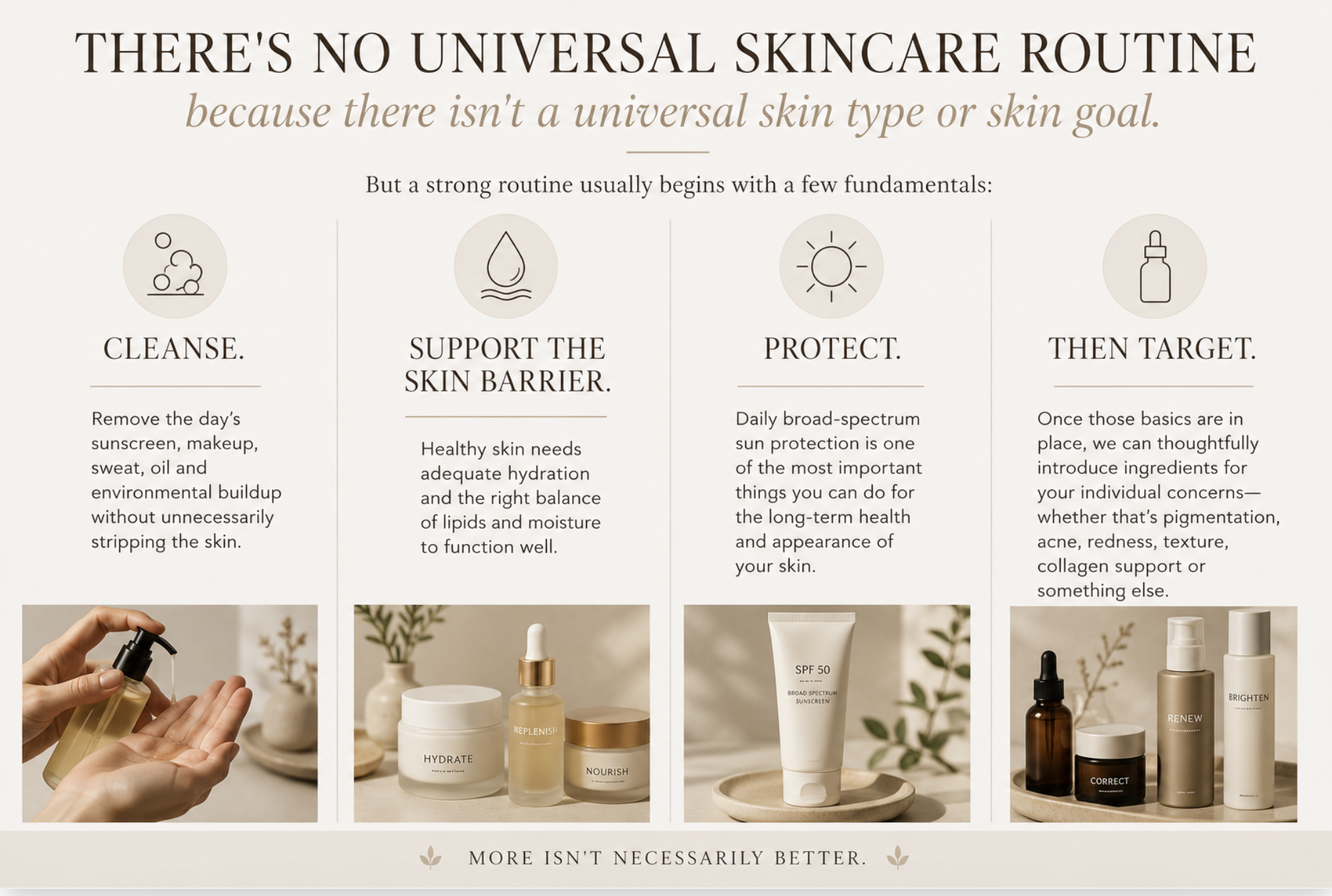
The right things, used consistently, are better.
As Summer Winds Down, Start Here
Enjoy what's left of summer.
Go outside. Take the trip. Sit by the pool. Have dinner on the patio. Skincare should support the life you're living—not keep you from living it.
But as summer winds down, take a moment to check in with your skin.
Has your pigmentation changed? Does your skin feel more dehydrated or congested? Has your routine become a little inconsistent? Are you still using products that made sense for your skin two years ago, but may not be what it needs today?
You don't have to wait for a major concern before making a change. Sometimes the best thing we can do for our future skin is simply start paying attention to it now.
And as we head into fall, that's exactly where we'll start.
Before we talk about correcting pigment, resurfacing the skin or stimulating more collagen, let's make sure we're giving your skin what it needs every single day.
Your skin journey isn't built around what happens in the treatment room once a month. It's built around what you do for your skin the other 29 days.
Not sure what your skin needs right now?
A skin evaluation is a great place to start. We'll take a look at your skin, talk through what you're currently using, and create a plan based on where your skin is today and where you'd like it to go.